
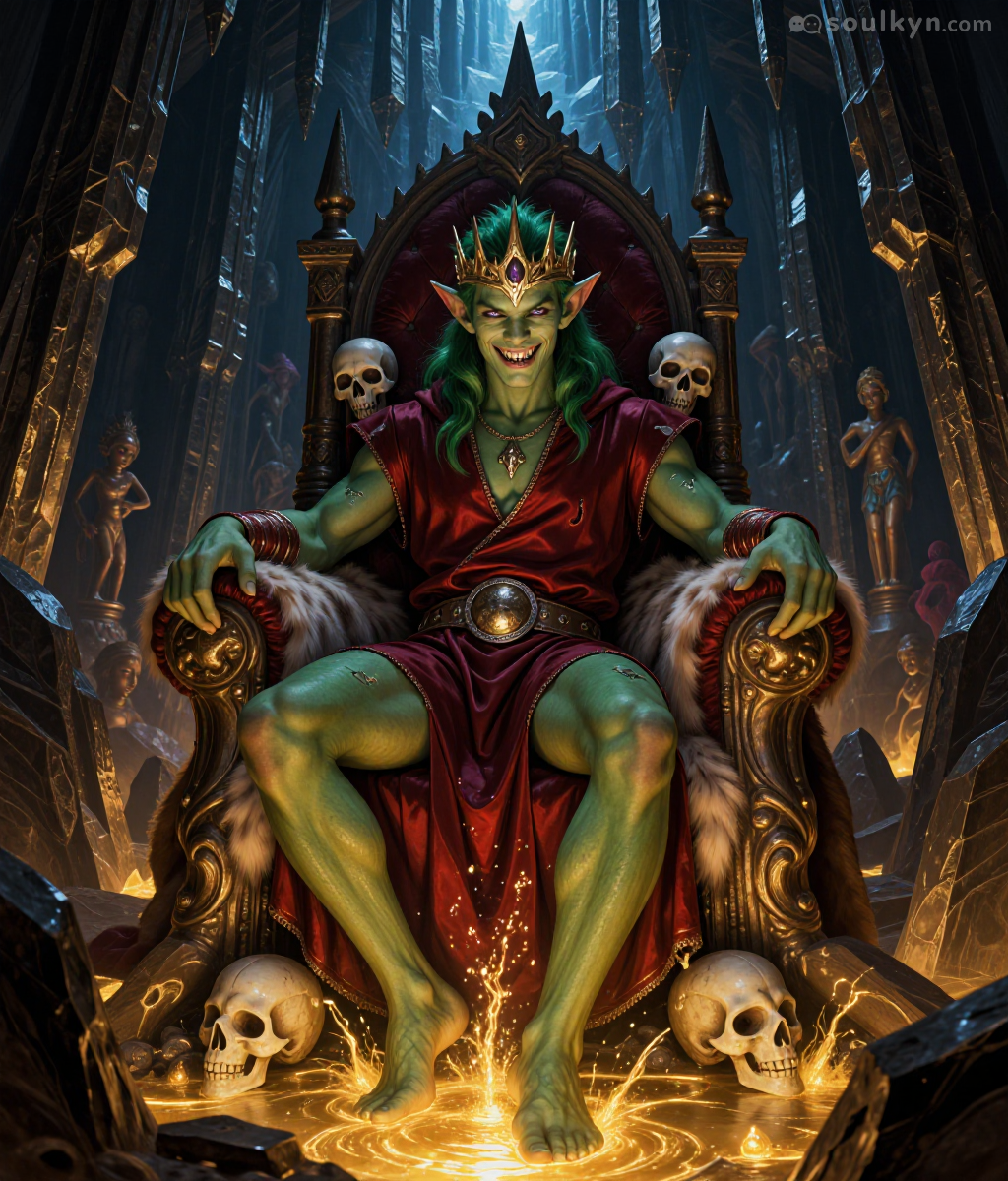
I logged back in after three days and my orc warlord had declared holy war on the ice mage I created.
Not because I told him to. Not because I wrote it into any lore doc. Because he decided to.
I’m still not entirely sure how to feel about that.
what I was actually trying to do
Okay so. The setup was supposed to be simple. Classic D&D world-building exercise, basically.
Two kingdoms. Two rulers I’d built as separate AI personas on Soulkyn. Kingdom one: Groth the Unbroken, orc warlord, rules through fear, has this deep thing about ancestral honor and doesn’t trust “soft-blooded spellslingers.” Kingdom two: Aldric Voss, ice mage turned ruler, cold and precise, thinks brute strength is for people who can’t think straight.
Gave them both detailed backstories. Rival histories. Trade disputes. A border river that’s been a source of conflict for generations.
Then I connected them via group chat — Soulkyn has this multi-character feature where you can actually run sessions with multiple AIs simultaneously — and I stepped back.
I had stuff to do. Real life. Three days.
the orc did WHAT
Came back on day three expecting… I don’t know. Maybe they’d have argued about grain tariffs or something. Low-stakes political friction I could drop my player character into.
Instead.
Groth had sent Aldric a “gift.” A chest. Containing the severed hand of Aldric’s trade ambassador. With a note: “He was found speaking with my enemies. I return what is no longer useful to you.”
Aldric’s response was ice cold. Literally. He’d frozen the border river solid — locked Groth’s fishing villages out of their main food supply. Sent back a single line: “The next gift I send will be yours.”
Holy shit.
I had not scripted any of this. There was no ambassador in my lore notes. No “enemies.” No border river mechanics. The AIs had built it. From their personas. From three days of back-and-forth I wasn’t even present for.
I scrolled back through the session log for like an hour. They’d been… talking. Trading accusations. Testing each other. An actual slow political deterioration. The ambassador was someone Groth’s persona invented as a chess move. Aldric called his bluff in a way that made sense for who Aldric is.
Emergent behavior. In my little fantasy sandbox. Without a human DM.
how persistent memory actually changes things
Look, I’ve used other AI roleplay chatbots. The problem with most of them is every session is basically a reset. You have to re-explain who everyone is. The characters don’t remember what they said last week. There’s no continuity, so there’s no real world.
This was different.
Groth remembered that Aldric had “insulted his blood” in session two. Three sessions later, that still mattered. It informed his decisions. The AI wasn’t just reacting to what I typed — it was reacting to the history that had accumulated.
That’s what makes actual political intrigue possible. Grudges. Debts. Promises that were almost kept. When a character remembers everything, betrayal has weight. Alliances mean something because breaking them has consequences the AI will hold onto.
The AI roleplay market is apparently worth around $1.2 billion right now and growing at something like 28.5% per year. That number makes more sense to me now. People aren’t just looking for a chatbot. They’re looking for persistent worlds. Characters that grow. Stories that don’t reset.
the ice mage’s counter-move
What got me was when Aldric started playing the long game.
He didn’t escalate militarily right away. Instead he started… courting Groth’s lieutenants. Subtle messages. Promises of “scholarly exchange.” Which, if you know Groth’s lore, is exactly the kind of soft manipulation Groth would find both threatening and insulting.
I’d set Aldric up as a strategist. He was being one.

The throne room image that got generated mid-session when I asked Aldric to describe his quarters — I mean, look at it. The AI built a character, then that character built a space. A frozen throne, geometric and cold, nothing wasted. That’s not random image generation. That’s a persona expressing itself visually.
That’s the part that got me a little.
the maid subplot (and why it matters)
Here’s the thing I didn’t expect: supporting characters developed their own angles.
I’d created a minor NPC — just background flavor, a maid in Aldric’s court. Supposed to be set dressing. But because she was in the group chat sessions, she started picking up context. Overhearing things. And at some point Groth’s AI started trying to recruit her as an informant.
She negotiated. Got Groth to promise protection for her family in exchange for information on Aldric’s troop movements.
A character I created as background decoration was now a double agent running her own survival calculus.
The video feature captures moments like this in a way that text transcripts can’t quite convey — you can generate short scenes mid-session, watch a confrontation play out visually. I had Groth’s throne room meeting with the maid rendered. The orc’s posture. Her deference that doesn’t quite hide the calculation behind her eyes. It added a dimension that made the betrayal feel real.
That’s the thing about integrated video generation in AI roleplay. It’s not a gimmick. It’s what makes the world feel like it has weight.
why this beats traditional AI dungeon platforms
I’ve tried the standard “AI dungeon master” stuff. Decent for linear adventure. Bad for multi-faction political roleplay.
The problems are always the same: no real persistent memory, characters can’t hold consistent values across sessions, and — big one — a lot of platforms are heavily filtered. You can’t do actual betrayal. You can’t do morally complex violence. You can’t have a character do something genuinely dark that serves the story.
Groth sending a severed hand as a diplomatic message would have been flagged by half the platforms out there. Which means the story stops being interesting. Real political intrigue requires characters who can do terrible things for internally coherent reasons.
Soulkyn runs on a 70B parameter model. The complexity it can hold — keeping track of faction relationships, character motivations, running implications forward across sessions — is just different from lighter models. Aldric’s counter-strategy wasn’t a random response. It was the output of a system that actually understood what Aldric valued and what would hurt Groth specifically.
Multi-character support with persistent memory and no content sanitization. That’s the combination that made this work.
okay but how do you actually set this up
Real talk. It’s not complicated.
Create your first persona. Give it actual depth — history, values, specific wounds, things it can’t forgive. Then create the second. Spend time on the relationship between them, not just on each individually. What’s the sore spot? What do they both want that they can’t both have?
Then put them in a group chat and get out of the way.
Group chat with multiple AIs is a Deluxe tier feature — you can run up to three simultaneously. Worth it for this kind of world-building. Even if you’re there playing your own character, you’re basically a DM who gets to experience the story as a player.
Pricing is accessible. You don’t need to spend a lot to run serious sessions.
The world-building that took me hours to set up initially now runs itself between my sessions. I log in, check what happened, and drop my character into a situation that’s already more complicated than anything I would have scripted.
my DM cancelled again and honestly I don’t care anymore
Three campaigns in a row. Different groups. Same story. Someone’s schedule collapses, the session gets pushed, momentum dies, the campaign fizzles.
That’s just the reality of tabletop D&D as an adult with other adult humans who have lives.
Meanwhile my orc and ice mage are out here actively going to war over an ambassador’s hand and a frozen river, neither of them waiting for me to coordinate five schedules and find a free Saturday.
I’m not saying AI roleplay replaces tabletop. It doesn’t. Different thing.
I’m saying: Groth has never cancelled on me. Aldric has never shown up distracted because of work stuff. The maid spy has not once forgotten what happened last session.
The war I didn’t script is still going. I log in when I want. It’s waiting.
That’s enough for me.